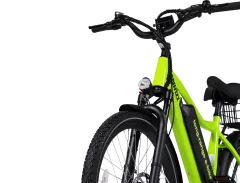
E-bike battery charging tips for delivery riders
Did you know that the way you charge your e-bike battery can greatly impact its lifespan? That's why we decided to make a list of e-bike battery charging tips that may help you to expend life or the battery.
Did you know that the way you charge your e-bike battery can significantly impact its lifespan and performance?
For delivery riders who rely on their e-bikes daily, proper battery care isn't just a suggestion—it's essential for maximizing uptime and reducing long-term costs.
This guide covers everything you need to know about e-bike battery charging tips, including how to extend battery life, avoid common mistakes, and get the most out of every charge cycle.
Understanding your e-bike battery
Most e-bikes, including the Storm-2 from Whizz, use lithium-ion (Li-ion) battery packs. These are the same chemistry used in smartphones and laptops, and they share similar characteristics: they're efficient, lightweight, and sensitive to charging and storage conditions.
Li-ion batteries degrade over time through charge cycles. A charge cycle is one full discharge and recharge — though partial charges count proportionally. Most e-bike batteries are rated for 500–1,000 cycles before capacity drops to around 80% of original.
How you charge and store your battery determines whether it reaches the top or bottom of that range.
Core charging tips for delivery riders
Don't run the battery to zero
Regularly deep-discharging a lithium-ion battery accelerates degradation. Ideally, recharge when the battery hits 20–30% remaining capacity.
For delivery riders on long shifts, this means planning charge breaks rather than waiting until the bike stops moving.
Don't leave it at 100% for extended periods
Keeping a lithium-ion battery at full charge for hours or days also causes stress. If you're not riding for a while, charge to around 80% rather than 100%.
Many e-bike chargers don't offer partial charge control, but you can time your charging: a full charge from low typically takes 4–6 hours. Stopping early by unplugging before 100% is a simple workaround.
Charge at room temperature
Extreme temperatures — hot or cold — damage lithium-ion cells during charging. Charge your battery indoors at room temperature (around 60–77°F / 15–25°C). In winter, let the battery warm up before plugging it in.
Use only the manufacturer's charger
Third-party chargers may deliver incorrect voltage or current, causing damage or safety hazards. Always use the charger that came with your e-bike. If you need a replacement, source one from the manufacturer or an authorized supplier.
Inspect the charging port and cable regularly
Delivery riders cover a lot of ground daily. Connectors and cables take wear. A damaged charging port can cause incomplete charges or short circuits. Check the port and cable for bent pins, corrosion, or visible damage.
How to extend battery lifespan
- Keep the battery between 20% and 80% for day-to-day use. Charge to 100% only when you need full range for a long shift.
- Store at 40–60% charge if you're not riding for several days or longer.
- Avoid heat exposure: Don't leave the battery in a hot car or direct sunlight. Heat is the most damaging environmental factor for lithium-ion cells.
- Avoid physical impact: Don't drop the battery or expose it to hard shocks. Internal damage can cause failure even if the casing looks intact.
- Clean contacts periodically: Use a dry cloth to keep the battery terminals and frame contacts clean. Corrosion causes resistance, which generates heat during charging.
Battery swapping: an alternative for high-usage riders
For delivery riders who cover 60+ miles per shift, waiting for a battery to recharge mid-shift is a major productivity cost. Battery swapping eliminates this problem.
Whizz offers a battery swapping service at select locations in NYC, Philadelphia, Washington DC, and Chicago. Riders bring in a depleted battery and swap it for a fully charged one in under five minutes. The first month is $1, and the plan is $49/month thereafter.
This approach also means the batteries at swap stations are maintained and replaced on a regular cycle — so you're always getting a battery in good condition.