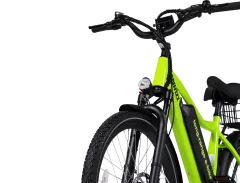
Best E-Bike for Food Delivery: How to Choose the Right One
Not every e-bike survives delivery work. Learn how to choose the best e-bike for food delivery, from battery range to UL certification.
Ask ten couriers what the best e-bike for food delivery is and you will get ten different answers — because the honest answer is that there is no single bike that wins for everyone. The right bike depends on your city, your hours, the weather you ride in, and how much weight you carry. What there is, however, is a clear set of features that separate a bike built to survive delivery work from one that will leave you stranded mid-shift.
That distinction matters more than brand loyalty. A delivery bike does not live the life of a commuter bike. It covers 40 to 60 miles a day across unpredictable routes, carries 30-plus pounds of food, stops and starts 20 to 30 times per shift, and gets ridden in rain and cold when casual riders stay home. A bike that handles a gentle weekend ride can fall apart fast under that load. This guide walks through exactly what to look for, the mistakes new couriers make, and how to match a bike to the way you actually work.
Why a Delivery E-Bike Is Different From a Commuter E-Bike
Specs come later. First, be honest about the job. Delivery is one of the hardest things you can ask of an e-bike, and it looks nothing like a commute:
- Mileage. A commuter might ride 10 miles a day. A full-time courier rides four to six times that, every working day.
- Stop-start cycles. Constant acceleration from a standstill — at every restaurant, every drop-off, every light — puts far more strain on the motor and drivetrain than steady cruising.
- Load. Insulated bags full of food add real weight, and that weight changes how the bike brakes, climbs, and handles.
- Conditions. Rainy nights are often the busiest, highest-paying shifts. A delivery bike has to be ridden in weather a commuter would avoid.
- Downtime cost. When the bike is your income, a breakdown is not an inconvenience — it is a lost shift. Reliability is a financial feature, not a nice-to-have.
This is why a good general-purpose e-bike can still make a bad delivery bike. The frame, brakes, battery, and rack all have to be built for sustained, loaded, all-weather use — not occasional errands. So here is what actually matters.
What Makes the Best E-Bike for Food Delivery: The Specs That Count
When you strip away the marketing, choosing the best e-bike for food delivery comes down to five things. Get these right and the rest is preference.
1. Battery range — the feature that ends shifts early
Range is the single most important spec for delivery work, because running out of charge mid-shift means cutting your earnings short. The mistake new riders make is buying for ideal conditions. Real-world range is always lower than the advertised number — cold weather, hills, heavy bags, traffic, and high assist levels all drain a battery faster.
A useful rule of thumb: an advertised range translates to roughly 60–75% of that in real delivery use. So a bike rated for 85 miles realistically gives a long, busy shift; one rated for 40 miles may leave you charging halfway through the day.
If your city has a battery-swapping network, that changes the math — a dead battery becomes a two-minute swap instead of a two-hour charge. Where available, it is one of the most practical solutions to range anxiety in delivery work.
2. Motor power — for hills, weight, and keeping pace
A delivery motor has to do three things well: climb hills, pull a loaded bike from a standstill, and keep up with city traffic. A 500W to 750W motor with solid torque handles nearly all delivery routes. Torque matters more than top speed here — you accelerate from a stop constantly, and a punchy, torquey motor saves energy and time on every restart.
Note that more top-end speed does not automatically mean faster deliveries. In dense downtown areas, traffic, lights, and braking set your real pace, not the bike’s maximum. Acceleration and control matter more than a high number on the spec sheet.
3. Brakes — non-negotiable for a loaded bike in traffic
A loaded delivery bike takes longer to stop than a light commuter bike, and you are braking constantly in unpredictable city traffic. Hydraulic disc brakes are the standard to look for. They deliver stronger, more consistent stopping power than mechanical brakes, and they hold up in rain — which, again, is when many of the best-paying shifts happen. This is a safety feature first and an efficiency feature second; do not compromise on it.
4. Cargo setup — a rack that can actually carry the load
Food delivery means carrying bulky, sometimes heavy orders, and the bag needs to sit stably. Look for a sturdy, integrated rear rack rated for real weight, not a flimsy accessory rack. A weak rack that lets the bag shift around makes the bike unstable and risks the order. Utility-style and purpose-built delivery bikes are designed with this in mind; many lightweight commuter bikes are not.
5. Battery certification — safety and legality in one spec
This one is easy to overlook and expensive to get wrong. The bike’s battery and electrical system should be UL-certified — UL 2849 for the e-bike system, UL 2271 for the battery. This is not just a quality marker. Uncertified lithium-ion batteries are a genuine fire hazard, and in cities like New York they are also illegal to sell or rent. We will cover the legal side in its own section, because for delivery riders it is not optional.
To pull it together, here is a quick reference for what "delivery-grade" looks like across the five specs: